New insights from ParFlow-CLM modeling
Last quarter, an automated workflow was developed to produce daily averages of saturation and pressure fields from the preliminary simulation in VTK format. This allows visualization teams to efficiently review an entire year of simulations.
At the same time, the model’s spatial resolution was tested: While the standard configuration uses a 100 m horizontal grid spacing, a test with 200 m resolution enabled a 50% faster calculation, though at the expense of an inaccurate representation of the drainage network. Therefore, further modeling will remain at 100 meters.
Future optimizations aim to reduce the number of vertical layers and make greater use of steady-state simulations, which require significantly less computation time.
Initial steady-state experiments, with a constant groundwater recharge of 176 mm/year, were conducted using the 100 m-resolution model and varying hydraulic conductivities (K) across two simplified hydrogeological units (HGU).
A higher K in the shallow, permeable unit (HGU 1) produced drainage networks that most closely matched observations, while changes in the top meter of soil strongly influenced the groundwater table. These results underscore the critical influence of the near-surface layer and help define priority zones for field measurements.
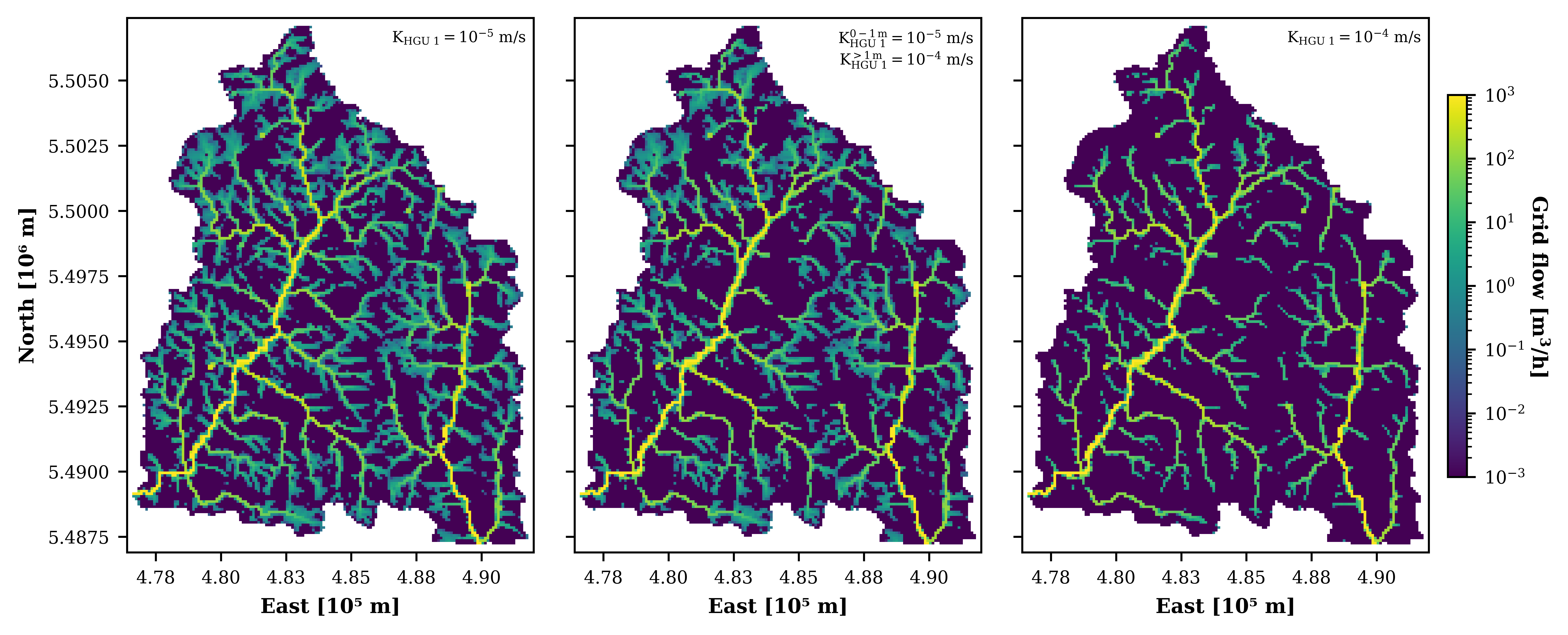
Drainage network for three steady-state experiments. For all cases KHGU 1 = 10-9 m/s.
As an example, the figure presents the simulated flow network for three model realizations that differ only in the K values assigned to HGU 1 and its uppermost meter.