Temperature Differences at Various Fracture Apertures
The model domain has a depth of 5000 m below ground level. The mountain surface is assigned an elevation of 200 m, whereas the valley is set at sea level. The matrix permeability is set to 1E-15 m², while the fracture permeability is set to 1E-10 m². Two fracture apertures, 0.1 m and 0.01 m, are considered. For the hydraulic boundary conditions, the top boundary is prescribed as constant atmospheric pressure, while the initial pressure within the domain is depth dependent. For the thermal boundary conditions, the top temperature is assumed to vary with elevation. Specifically, the valley temperature is set to 10 °C and decreases with elevation at a lapse rate of 0.03 °C/m; consequently, the mountain-top temperature is 4 °C. The temperature differences between the fractured models and the unfractured reference model are shown in Figure A. The results indicate that the model with the larger fracture aperture develops more pronounced high-temperature zones around the fracture, accompanied by stronger hydraulic transport along the fracture pathway.
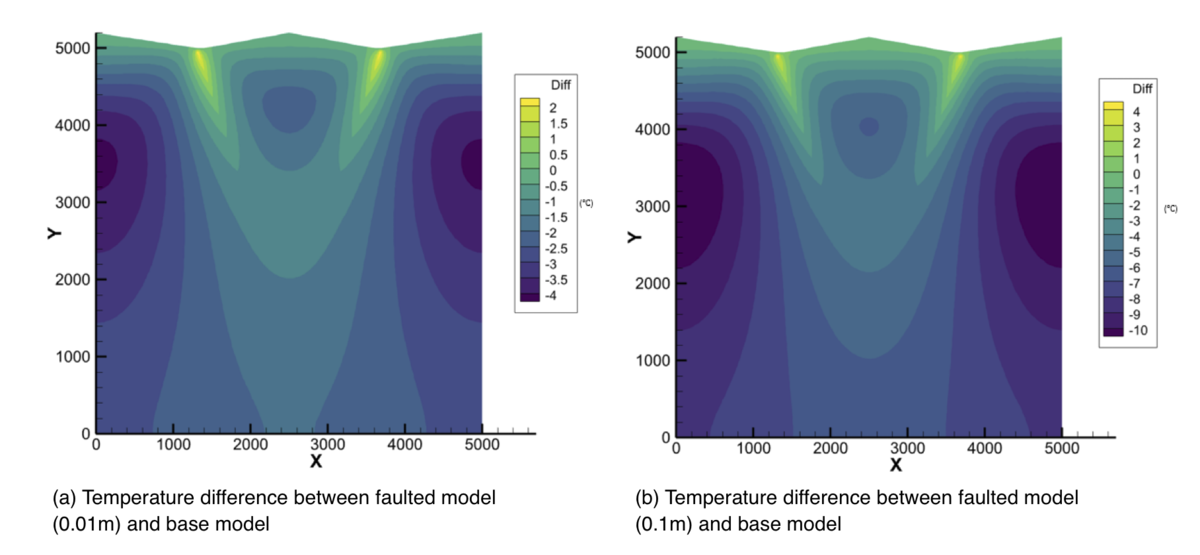
Temperature difference between the fractured model and the unfractured reference case.