Connecting the Drilling Simulator with the Hydraulic Model
A key update to the Drilling Simulator is the proper integration of fluid density into the hydraulic model. By resolving previous inconsistencies in the parameters, the simulation now produces a physically consistent interaction among pressure, obstacle height, and flow rate, making it more realistic. Density directly influences pressure buildup, energy transfer, and system response.
Based on this, a pump model based on “head gain” was implemented. Pumps serve as energy sources that add hydraulic head to the network, enabling reliable simulation of stable high-pressure scenarios (≥ 200 bar)—a must for drilling and safety simulation tasks.
At the same time, pressurized tanks were expanded to include variable fill levels. The model dynamically couples volume, inflow, and outflow, enabling a realistic representation of tank containers and future accumulators with pressure-volume coupling, as shown in the figure.
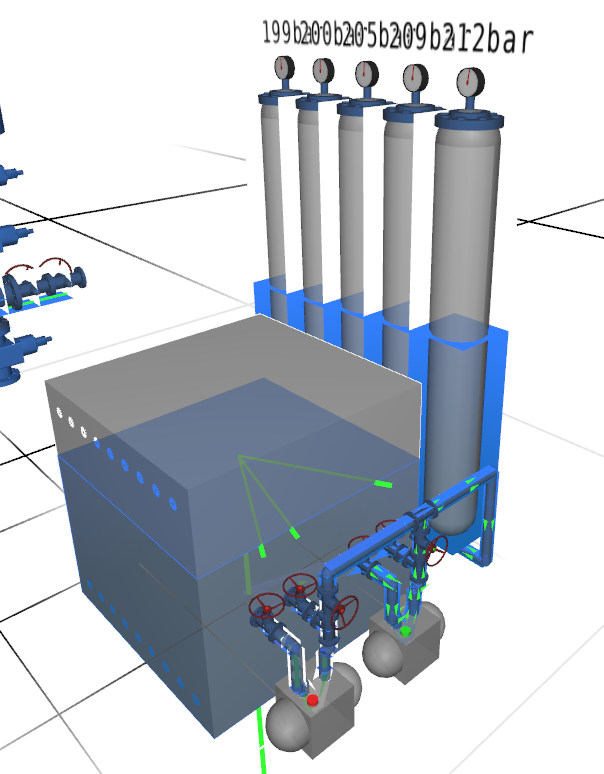
Accumulator to store pressure and control the BOP
The valve and control components have been supplemented by a dynamic resistance framework. While existing valves remain unchanged, additional control valves can now adjust their resistance at runtime, making them ideal for blowout preventers (BOPs), choke lines, and other safety-critical systems.
The unified network architecture enables the modeling of complex hydraulic layouts, ranging from surface to downhole equipment. Combined with physically consistent fluid modeling, this results in a robust simulation tool that delivers realistic high-pressure and control scenarios for modern deep-well drilling and safety applications.